




vc.web.local

twitter Facebook linkedin acp

Geology & Geophysics

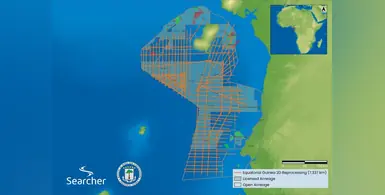
The project aims to deliver actionable insight. (Image source: Searcher)

Ahead of the EG Ronda 2026 licensing round set to be held in Equatorial Guinea, geoscience data solutions provider, Searcher, has launched a major seismic reprocessing initiative covering 8,500 km of offshore data from the region

Promising highest-resolution imaging with fast-track results available immediately and final deliverables scheduled for release before the round opens in April 2026, bidders can expect convenience when it comes to de-risking efforts. 

As the government prepares to offer up to 24 blocks in the upcoming licensing round, these will be backed by Searcher's latest broadband pre-stack depth migration (PSDM) and full waveform inversion (FWI) techniques-driven reprocessed legacy datasets, ensuring high-definition view of the subsurface for confident decision-making.

“This project is about more than reprocessing data—it’s about delivering actionable insight,” said Alan Hopping, Managing Director of Searcher. “By combining cutting-edge imaging with fast-track delivery, we’re giving explorers a head start and helping Equatorial Guinea showcase the true potential of its offshore basins.”

The initiative aligns with the Ministry of Mines and Hydrocarbons’ goal of revitalising the energy sector and stimulating new exploration activity. With results available ahead of the licensing round, Searcher’s work provides a powerful foundation for evaluating opportunities and unlocking the next phase of offshore discovery.

The acquisition is scheduled to commence in the fourth quarter of this year.

Energy data and intelligence provider, TGS, has been awarded a streamer acquisition contract in Africa 

The acquisition is scheduled to commence in the fourth quarter of this year and the contract has a duration of approximately 50 days.

Kristian Johansen, CEO of TGS, said, "We are very pleased to secure this work programme and look forward to supporting our client's exploration efforts in the region with our proven technology and expertise. By leveraging the Ramform acquisition platform, coupled with our proprietary GeoStreamer technology we are well equipped to deliver the highest data quality to our client." 

TGS has previously worked in regions such as Benin, Tanzania and Liberia. For its Benin MegaSurvey it expanded its 3D seismic coverage, while in Tanzania it has acquired license for more than 132,000 sq kms of seismic data, both 2D and 3D.

In Liberia, the company is working to rejuvenate the existing legacy 2D and 3D datasets in the Liberia and Harper Basins, aspiring to reach high subsurface clarity

High-quality seismic data is important to unlock Libya's vast resource potential. (Image source: Stryde)

Libya's Arabian Gulf Oil Company has collaborated with TAY Oil Services and Polaris to initiate a survey onshore Concession 57 with the deployment of Stryde's onshore nodal seismic solutions 

High-quality seismic data is important to unlock Libya's vast resource potential, as the country reopens to investors for exploration and development prospects. This can be achieved with Stryde's semi-automated, containerised system, featuring 40,000 seismic nodes, which promise shortest possible turn-over. A single operator can rotate 13,000 nodes within 24 hours by using the containerised system. These nodes can reach exceptional depths, eliminating surface interference for best possible coupling to achieve optimal data quality. The survey operations can be conducted flawlessly without disrupting production activities or the surrounding environment. The streamlining makes large-scale, high-density seismic surveys more efficient and cost-effective.

Abdellatif Hakkoumi, Polaris regional manager, said, “To meet the rising demand for high-resolution seismic imaging across expansive areas of Libya, we required an innovative nodal system capable of supporting a high channel count, without the logistical and financial constraints of conventional systems.

"With the quick delivery of Stryde’s fully autonomous nodes and semi-automated containerised seismic system, we have rapidly transitioned into a new era of land seismic acquisition.

"This advanced technology enables us to dramatically increase trace density per square kilometre. As a result, our customers benefit from improved subsurface imaging, reduced geological uncertainty, optimized well placement, and lower drilling risks, ultimately increasing exploration success rates.”

Stryde’s Containerised Seismic System, housed within a 20ft shipping container, seamlessly integrates all essential hardware for semi-automated node charging, harvesting, and on the fly generation of seismic data deliverables.

Mehdi Tascher, sales director at Stryde, said, “This purchase marks a significant milestone in the advancement of seismic exploration in Libya. With our state-of-the-art seismic system, TAY Oil-Polaris is set to carry out the largest nodal seismic acquisition project ever conducted in North Africa and will be able to meet fully Libyan onshore seismic growing demand.

“We are proud to supply TAY Oil-Polaris with the industry’s only fully integrated and semi-automated seismic system, enabling unprecedented operational efficiency while delivering high-resolution seismic data to their Libyan customers.”

“Libya’s complex geology, defined by thick carbonate sequences and rugged terrain, poses significant challenges for accurate subsurface imaging. To overcome these obstacles, high-density sensor deployment is essential for delivering superior structural and stratigraphic resolution. By harnessing STRYDE’s advanced nodal system, TAY Oil-Polaris is uniquely equipped to navigate these complexities.”

Stryde’s technology offers true scalability for large-scale seismic acquisition. (Image source: Stryde)

Exploration services company, Argas, has purchased 30,000 Range+ STRYDE nodes and Stryde’s Nimble Seismic System, marking the first-ever deployment of nodal technology for onshore seismic acquisition in Egypt

The first deployment of the newly acquired Stryde system will be on a very large 2D seismic survey in Egypt. The technology will be used to acquire high-quality seismic data across highly prospective sedimentary basins, supporting oil and gas exploration efforts in one of Egypt’s most promising frontier regions.

Impressed by its cost-efficiency and operational agility, Argas made the strategic decision to integrate Stryde’s technology into its operations.

Stryde’s technology offers true scalability for large-scale seismic acquisition. Its ultra-lightweight Range+ nodes, coupled with a state-of-the-art, high-capacity charging, harvesting, and QC ecosystem, enable thousands of nodes to be rotated daily.

This ensures faster acquisition cycles and rapid delivery of high-quality seismic data, giving Argas a competitive edge in Egypt’s rapidly evolving energy sector.

“After working with Stryde’s system on previous projects, it became clear that this technology brings a significant advantage to both us and our clients,” said Soufiane Azzi, Director of Commercials and Collaborations of Argas.

“The system has proven to drastically reduce deployment time, reduce headcount and vehicles count, simplifies logistics, improve recording time window, and delivers excellent seismic data. We are proud to be the first to bring node technology to Egypt.”

“This is a major milestone, not only for STRYDE and ARGAS, but for Egypt’s energy sector as a whole,” said Mehdi Tascher, sales director at Stryde.

“ARGAS’s purchase is spot on, and reflects the growing demand for scalable and efficient seismic acquisition systems that enable high-density data capture for superior subsurface imaging, empowering more confident and informed exploration decisions. This sale underscores the global trust in STRYDE’s technology and its proven ability to transform seismic operations through operational excellence and data quality.”


A single well location can now be pinpointed at Oryx prospect. (Image source: Pancontinental Energy)

Pancontinental Energy has released revised estimates of prospective resources for the company's PEL 87 project, Orange Basin offshore Namibia

Pancontinental chief executive officer, Iain Smith, said, "The Pancontinental technical team continues to deliver, such that we are now able to pinpoint a single well location at the Oryx prospect that offers oil potential at three discrete intervals for a combined 2.5 billion barrels of High Case prospective resource, with a Geological Chance of Success upgraded to 26.2%."

The Oryx prospect now incorporates the prospective features previously identified as the Calypso and Addax Channel leads, due to the fact that it has been determined that all three targets may be effectively tested by a single exploration well. As a result the High Case (3U) prospective resource estimate (gross, 100%) for Oryx now stands at over 2.5bn barrels of oil, recoverable.

Of note is that, in general terms, it is the Best Case (2U) prospective resource estimates which have most benefited from the revised inputs, in particular for Oryx and Hyrax (due to their relative maturity, as prospects). The Low Case (1U) and High Case (3U) for each prospect/lead is affected to a lesser degree and the prospective resource estimates for the Addax Fan and Addax South leads remain unchanged, as does the GCoS. The GCoS for the remainder of the prospect/lead inventory has increased, based upon seismic synthetic modelling which provides positive indications for a hydrocarbon fluid effect (interpreted as a low gas-oil-ratio oil). As such the estimated GCoS for the main Oryx prospect now stands at 26.2% (previous estimate 22.5%).

QI screening is currently on, generating a mapping of an additional prospective feature, external to the Saturn Complex. The Phoebe West lead is interpreted as an Albian-to-Aptian basinal turbidite fan feature fed by a long-lived northern channel clastic bypass depositional system. Interpretation of this feature is ongoing at this time and Pancontinental anticipates providing further detail soon.


More Articles …