






Local content in Namibia was first considered at a policy level in 2021, until back to back Orange Basin discoveries the year after pushed the Cabinet to formally sanction the structured development of a comprehensive framework
Thanks to high-profile discoveries like Shell's Graff-1 and TotalEnergies' Venus-1X fields, the sudden inflow of substantial foreign capital required channelising in a way that keeps benefiting Namibian locals across generations; this was addressed in the new framework. Following years of nation-wide consultations at both ministerial and industrial levels, the Cabinet has now approved the National Upstream Petroleum Local Content Policy. This will ensure legal security for local participation across the upstream petroleum value chain.
Namibia Oil and Gas Conference and Exhibition
Local content set the tone for the recently held Namibia Oil and Gas Conference and Exhibition (NOGC) in Windhoek, and factors that drove the sessions and conversations included:
Capitalisation of petroleum opportunity
Generation of long-term national value
Advancing investments and businesses
Skills and jobs creation
“Discovery is not the destination. A resource beneath our waters becomes a national success only when it is responsibly developed and translated into tangible improvements in the lives of our people. It must become employment for Namibians, opportunities for our enterprises, skills for our young people, technology for our institutions, infrastructure for our economy, revenues for national development, and savings for future generations. This is why the theme of this conference is particularly appropriate,” said Lucia Witbooi, Vice President of the Republic of Namibia.
From Decision to Dividend: Making Namibia’s Oil Work for Namibians was the theme for the three-day conference hosted by the Economic Association of Namibia (EAN) in partnership with the Hanns Seidel Foundation (HSF) and the Namibia Investment Promotion and Development Board (NIPDB), with strategic partners the National Petroleum Corporation of Namibia (NAMCOR) and SNC Incorporated. The conference was officially endorsed by the Ministry of Industries, Mines and Energy.
“Our strategic plan for 2026 to 2030 carries one organising idea, which is to move this country from exploration to readiness, so that Namibia is ready onshore when production begins offshore. Namibia expects Namibian employment to be maximised, Namibian suppliers prioritised, skills and technology transferred, and meaningful Namibian participation, ownership and financing across the value chain.
"Fiscal certainty is a stable and transparent framework for petroleum revenues. Namibia does not move the goalposts. To our international partners: local content, properly done, is not a tax on your investment. An industry surrounded by capable Namibian suppliers, skilled Namibian workers and invested Namibian communities is an industry with social licence, political stability and a future measured in generations. That is what the policy builds, and my ministry will implement it with you, not against you. I am happy to state that our local banks have informed me that they are ready to receive bankable proposals from the oil and gas sector for their consideration,” said Modestus Amutse, the Minister of Industries, Mines and Energy.
From exploration to development
Namibia is currently transitioning from exploration towards development, and local content remains the core of this journey. The administration is increasingly focusing on:
Enterprise participation
Skills exchange and development
Infrastructure building
Financing and investment
“Oil is not the point; oil is actually the how. Our people are the why,” said Jason Kasuto, chairperson of the Economic Association of Namibia and managing director of Monasa Advisory & Associates.
The event saw Namibian business persons and policymakers strategising on ways to advance local participation at the Local Content Masterclass segment. There was also the NIPDB Local Content Pitching Session, where entrepreneurs pitched concepts and sought partnership opportunities with industry leaders and investors. Supplier workshops educated domestic businesses on international industry standards as the means to expand influence.
Namibia's local content drives NOGC 2026
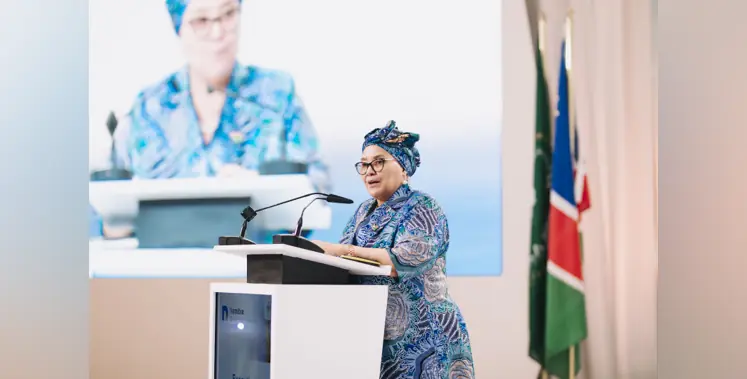
Lucia Witbooi, Vice President of the Republic of Namibia at NOGC 2026. (Image source: NOGC)