






Research firm, Rystad Energy, has predicted strong momentum to remain steady in Africa's exploration scene as operators are showing healthy risk appetites with wildcat drilling activities lined-up in the region
High-impact wildcat wells were already trending in 2024 and 2025, reporting sharp success rates at 23% and 38% respectively. In a year-on-year basis, high-impact drilling has added around 2.3 billion barrels of oil equivalent, recording a 53% boost in volumes.
This will continue to be prevalent well into 2026 with Africa's Orange Basin and Gulf of Guinea driving global activity at around 40% of planned high-impact exploration wells. Almost all onshore high-impact drilling this year is expected to come from Africa, as Rystad notes a clear concentration in ultra-deepwater and frontier exploration.
“What we are seeing in 2026 is a clear shift in where operators are willing to deploy capital. Ultra-deepwater and frontier plays remain capital-intensive, but they also offer scale and material upside at a time when conventional opportunities are increasingly limited. Africa stands out because it still combines geological potential with the prospect of large, commercially meaningful discoveries, particularly for operators looking to secure long-life resources in a tightening global supply environment,” said Aatisha Mahajan, head of exploration, oil & gas research, Rystad Energy.
Factors that determine how high-impact a well is include resources size, potential hydrocarbon plays in frontier or emerging basins, and their significance to the operator.
Africa to lead high-impact wildcat wells exploration
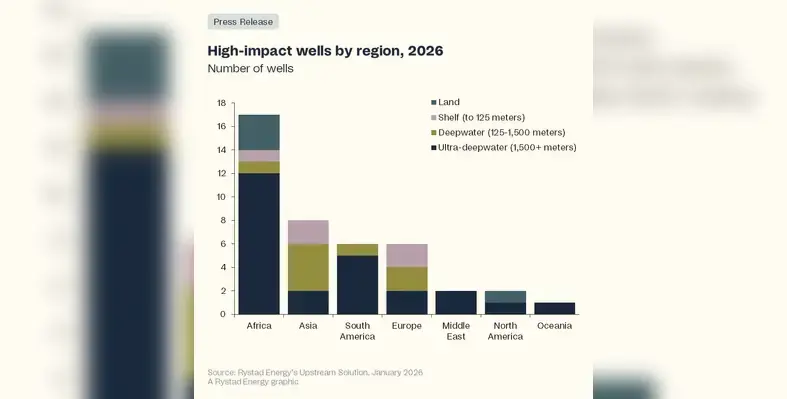
Africa will drive global activity. (Image source: Rystad Energy)