






"The first thing that is important for the overall management of the company is to start trying to be visible," said the group chief executive officer of Nigerian National Petroleum Company, Bashir Bayo Ojulari, at the International Energy Week, while speaking to Andy Brown, the president of Energy Institute, which recently hosted the event's seventh edition in London
As the NNPC works towards achieving 3 million barrels of oil per day by 2030, the government-turned-private company is reviewing its portfolio as it undergoes major revisioning and restructuring. Ojulari hailed this as a very bold step on the Nigerian President's part, especially because the injection of international oil company veterans complemented the company's regional structure to form a new leadership team.
"Based on what we have seen so far, we are firstly restructuring the shape of our partnerships. Majority of our production, as you know, is in partnership with Shell, ExxonMobil, and other private companies. We focused on aligning our programmes and plans with these partners so that we have a joint committee," he said, alongside highlighting financing as a second challenge, which is also driving the company's portfolio decisions.
NNPC's vision lies in pushing industrialisation within Nigeria and the rest of sub-Saharan Africa, while expanding the localisation of both oil and gas. The company's focus on meeting energy demand within Africa stands clear even at international platforms such as the Organisation of the Petroleum Exporting Countries, where its strategy is more about deepening utilisation of its own resources than just producing and exporting. To ramp up expansion on the downstream side, the major Dangote refinery besides, several local refineries are currently operational as well. NNPC has thus identified significant downstream projects that can potentially support additional power generation, industrial gas-based industries, fertilisers and petrochemical points. Last year alone five agreements have been signed to advance utilisation across the region.
Gas is also a major element for NNPC in catapulting industrialisation in Africa. For starters, industrial parks in Nigeria were identified as supply points for mass consumption. These will be brought under the mega-infrasrtucture of the highly anticipated Ajaokuta–Kaduna–Kano Natural Gas Pipeline and the Obiafu-Obrikom-Oben pipeline projects that are ready for commissioning this year. The combined capacity of these two pipelines are set to exceed 2 billion cubic feet of gas per day.
"We're passionate about connecting Africa," said Ojulari as he mentioned the African Atlantic Gas Pipeline that is set to run across West Africa down to Morocco. Expressing excitement regarding the project's viability inspite of its challenges, he said, "But today it's commercially very profitable venture...our plan is to just go in chunks. So the next is to go to Ivory Coast." Assuring that a list of countries are lined up to join the project, he explained, "Some of those countries also have gas resources, but they do not have the economy or scale. So the idea of that pipeline is that those countries that have stranded gas can also connect their gas to the pipeline as well as take the gas."
Having served six years as the managing director of Shell Nigeria Exploration and Production Company, Ojulari's new role demands fresh approach towards success. "In Shell and in other IOC companies...we focus on the financial side of the opportunity...And then when we are all done, let's look at the non technical," he said while explaining how IOCs have their own framework with technical, economic, commercial, organisational and political aspects. And once all that are figured out, they check the competition in the industry.
On the other hand, speaking of his new role, he said, "We can't afford to do that in my world. We start with the political...It becomes more critical because here NNPC is owned by the 230 million Nigerians. They are shareholders. They have appointed two entities -- the finance ministry and the petroleum industry to be the holders of the shares. So our accountability is to these 230 million people. We cannot afford to exclude ourselves from the political structure. We are carrying people along...bringing in the key people."
He went on to add, "We are starting a project. You need to bring somebody from the Minister of Finance. We bring them up. So that way we all get to be part of the project. We're making progress...we are more confident, and we are getting a lot of support in terms of the direction we're going."
According to Ojulari, establishing capital and organisational discipline is critical in achieving operational excellence and NNPC's future repositioning. He acknowledged the role of the company's leadership in bringing on board the sheer knowledge around how exploration and production businesses should be run, and how that knowledge is being transmitted to the country's gas power, new energy and downstream business. This also allows the company to be prepared to demonstrate "what it looks like" as when political influence comes into question, a lot depends "around the ability to show what it looks like".
While the fundamental structures around the paperwork are in place for NNPC's transition into a private company post the Petroleum Industry Act 2021, changing the deep-rooted culture still remains one of the biggest challenges. "From being a corporation to a privately owned company, what we have realised is that the Nigerians are not fully clear of the [transition]. It requires a lot of interaction."
The community-based surveillance structure that has been introduced by the government to address oil theft issues in Nigeria has proved a success on this matter. Involving the combined efforts of not just the security forces but also the community, a 100% availability was achieved in production reconciliation in the terminals, which earlier went as low as 10%.
"Most times we look at [such] challenges from a security perspective, but is a fundamental social problem. Here you have an environment where you still need a lot of development and a lot of social structure. So what was unique about this surveillance structure was that it was a community based surveillance structure which then combined the effort of the community as well as the effort of the security forces. And what we started to see is that once we integrated and focused on development of the communities as well, we started achieving 100% availability...for the last nine months now," said Ojulari.
NNPC's gas projects to connect Africa
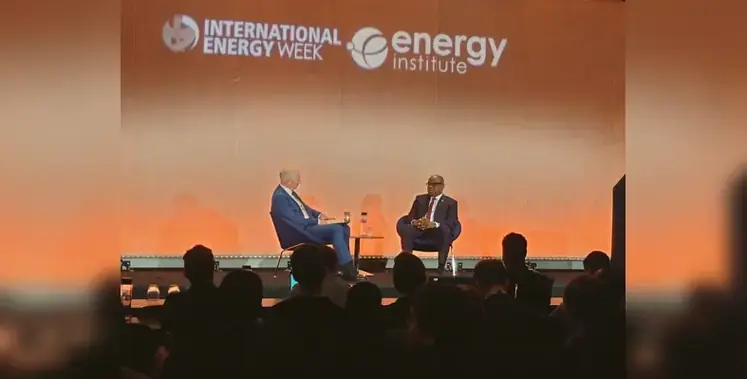
NNPC is reviewing its portfolio.